William Read Reed Reade Massachusetts Bay Colony
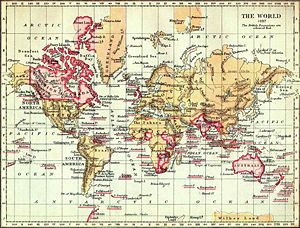
The British Empire in 1897, marked in pink, the traditional color for Imperial British dominions on maps
The British Empire is the virtually extensive empire in earth history and for a time was the foremost global ability. It was a product of the European age of discovery, which began with the global maritime explorations of Portugal and Spain in the tardily fifteenth century.
By 1921, the British Empire ruled a population of betwixt 470 and 570 one thousand thousand people, approximately one-quarter of the world's population. Information technology covered about fourteen.3 million square miles (more than than 37 million foursquare kilometers), about a quarter of Earth's total land expanse. Though it has now by and large evolved into the Democracy of Nations, British influence remains stiff throughout the world: in economic practice, legal and governmental systems, sports (such as cricket and football), and the English linguistic communication itself.
Did you know?
The British Empire was known as "the empire on which the sun never sets"
The British Empire was, at one fourth dimension, referred to as "the empire on which the sun never sets" (a phrase previously used to describe the Spanish Empire and later to American influence in the world) because the empire's span across the globe ensured that the sun was ever shining on at least ane of its numerous colonies. On the 1 mitt, the British adult a sense of their own destiny and moral responsibleness in the world, believing that many of her colonial subjects required guidance, that it was British rule that prevented chaos and chaos. Positively, the instruction system sponsored by the British promulgated an sensation of such values every bit freedom, human dignity, equality—fifty-fifty though those taught frequently observed that their colonial masters did not practise what they preached. Negatively, peoples and resources were exploited at Britain'due south advantage and more oftentimes than not at the cost of her overseas possessions.
Contents
- ane Etymology
- 2 Groundwork: The English Empire
- ii.1 Growth of the overseas empire
- 2.2 Henry Viii and the rise of the Royal Navy
- 2.iii Republic of ireland
- 2.4 The Elizabethan era
- 2.v The Stuart era
- 2.6 Scottish role
- three Colonization
- 4 Free merchandise and "breezy empire"
- v British East India Company
- v.ane Expansion
- 5.ii Collapse
- 6 Breakdown of Pax Britannica
- seven Britain and the New Imperialism
- vii.1 British colonial policy
- 8 Britain and the scramble for Africa
- 9 Home rule in white-settler colonies
- ten The impact of the Kickoff World War
- x.ane The cease of British rule in Republic of ireland
- eleven Decolonization and decline
- 12 Legacy
- thirteen See also
- 14 Notes
- 15 References
- 15.1 Overviews
- 15.2 Specialized scholarly studies
- xvi External links
- 17 Credits
Many British thought their ascendancy providential, part of the divine plan. Anyone who believes that history is not merely a series of accidents might well see God's hand behind the cosmos of an empire that, despite all the ills of an purple system imposed on unwilling subjects, also left a cultural, literary, legal and political legacy that binds people of different religions and races together.
Etymology
The term "British Empire" was oftentimes used after 1685; for case, in John Oldmixon's volume The British Empire in America, Containing the History of the Discovery, Settlement, Progress and Present State of All the British Colonies, on the Continent and Islands of America (London, 1708).[1]
Groundwork: The English Empire
Growth of the overseas empire
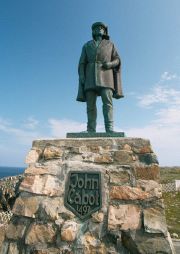
Statue of John Cabot in Newfoundland, site of England's first overseas colony
The origin of the British Empire as territorial expansion beyond the shores of Europe lies in the pioneering maritime policies of King Henry Seven, who reigned 1485 to 1509. Building on commercial links in the wool trade promoted during the reign of King Richard 3 of England, Henry established the modern English merchant marine organization, which profoundly expanded English shipbuilding and seafaring. The merchant fleet also supplied the basis for the mercantile institutions that would play such a crucial role in later British imperial ventures, such every bit the Massachusetts Bay Company and the British East India Visitor chartered by Henry's yard-daughter, Elizabeth I. Henry's fiscal reforms made the English Exchequer solvent, which helped to underwrite the development of the Merchant Marine. Henry as well ordered structure of the first English dry dock at Portsmouth, and fabricated improvements to England'south pocket-sized Royal Navy. Additionally, he sponsored the voyages of the Italian mariner John Cabot in 1496 and 1497 that established England's first overseas colony—a angling settlement—in Newfoundland, which Cabot claimed on behalf of Henry.
Male monarch Henry VIII founded the modern English navy (though the plans to do and so were put into motion during his male parent's reign), more than tripling the number of warships and constructing the first large vessels with heavy, long-range guns. He initiated the Navy'southward formal, centralized authoritative apparatus, congenital new docks, and constructed the network of beacons and lighthouses that fabricated coastal navigation much easier for English and foreign merchant sailors. Henry established the munitions-based Regal Navy that was able to agree off the Spanish Fleet in 1588.
Ireland
The get-go substantial achievements of the colonial empire stalk from the Act for Kingly Title, passed by the Irish parliament in 1541. This statute converted Ireland from a lordship nether the authority of the English crown to a kingdom in its own right. It was the starting point for the Tudor re-conquest of Ireland.
By 1550 a committed policy of colonization of the country had been adopted, which culminated in the Plantation of Ulster in 1610, following the Nine Years War (1595-1603). These plantations would serve every bit templates for the empire. Several people involved in these projects also had a hand in the early on colonization of North America, including Humphrey Walter Raleigh and Francis Drake. The Plantations were large tracts of state granted to English and Scottish settlers, many of whom enjoyed newly created titles.
The Elizabethan era
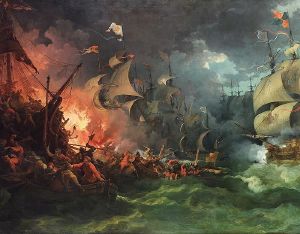
Defeat of the Castilian Fleet, by Philippe-Jacques de Loutherbourg (1796)
During the reign of Queen Elizabeth I, Sir Francis Drake circumnavigated the earth in the years 1577 to 1580, fleeing from the Castilian, merely the second to accomplish this feat after Ferdinand Magellan's trek.
In 1579 Drake landed somewhere in northern California and claimed what he named Nova Albion for the English Crown (Albion is an ancient name for England or Uk), though the claim was non followed by settlement. Subsequent maps spell out Nova Albion to the due north of all New Spain. England's interests exterior Europe at present grew steadily, promoted by John Dee (1527-1609), who coined the phrase "British Empire." An expert in navigation, he was visited by many of the early on English explorers before and after their expeditions. He was a Welshman, and his use of the term "British" fitted with the Welsh origins of Elizabeth'south Tudor family, although his conception of empire was derived from Dante Alighieri'southward book Monarchia.
Sir Humphrey Gilbert (1537-1583) followed on Cabot'southward original claim when he sailed to Newfoundland in 1583 and declared it an English language colony on August 5 at St. John'due south, Newfoundland and Labrador. Sir Walter Raleigh organized the first colony in Virginia in 1587 at Roanoke Island. Both Gilbert'due south Newfoundland settlement and the Roanoke colony were short-lived, however, and had to exist abased due to food shortages, severe weather, shipwrecks, and hostile encounters with ethnic tribes on the American continent.
The Elizabethan era built on the by century's majestic foundations by expanding Henry VIII's navy, promoting Atlantic exploration by English language sailors, and further encouraging maritime trade especially with the Netherlands and the Hanseatic League, a Baltic trading consortium. The virtually twenty year Anglo-Castilian War (1585-1604), which started well for England with the sack of Cadiz and the repulse of the Castilian Armada, soon turned Spain'due south fashion with a number of serious defeats which sent the Purple Navy into decline and allowed Espana to retain effective control of the Atlantic sea lanes, thwarting English language hopes of establishing colonies in North America. However it did give English sailors and shipbuilders vital feel. Rivalry between the British, the Dutch and the Spanish reflected both commercial and territorial competition but besides the Protestant-Catholic divide.
The Stuart era
In 1604, Male monarch James I of England negotiated the Treaty of London, ending hostilities with Spain, and the showtime permanent English settlement followed in 1607 at Jamestown, Virginia. During the next iii centuries, England extended its influence overseas and consolidated its political development at habitation. In 1707, under the Acts of Matrimony, the Parliament of England and the Parliament of Scotland were united in Westminster, London, as the Parliament of Great Britain.
Scottish role
There were several pre-union attempts at creating a Scottish Overseas Empire, with various Scottish settlements in Due north and Due south America. The most famous of these was the disastrous Darien scheme which attempted to establish a settlement colony and trading post in Panama to foster trade betwixt Scotland and the Far East.
After wedlock many Scots, particularly in Canada, Jamaica, India, Commonwealth of australia and New Zealand, took up posts as administrators, doctors, lawyers and teachers. Progressions in Scotland itself during the Scottish enlightenment led to advancements throughout the empire. Scots settled across the Empire every bit it adult and built up their own communities such as Dunedin in New Zealand. Mainly Calvinist, the Scots had a strong work ethic which was accompanied past belief in philanthropy as a religious duty, all of which impacted on the education system that was adult throughout the empire.
Colonization
Jamestown, under the leadership of Helm John Smith (1580-1631), overcame the severe privations of the winter in 1607 to found England's first permanent overseas settlement. The empire thus took shape during the early seventeenth century, with the English settlement of the 13 colonies of North America, which would later become the original United States as well as Canada's Atlantic provinces, and the colonization of the smaller islands of the Caribbean such equally Jamaica and Barbados.
The sugar-producing colonies of the Caribbean, where slavery became the footing of the economy, were at offset England'due south most important and lucrative colonies. The American colonies provided tobacco, cotton fiber, and rice in the Due south and naval materiel (military hardware) and furs in the North were less financially successful, just had large areas of expert agricultural state and attracted far larger numbers of English language emigrants.
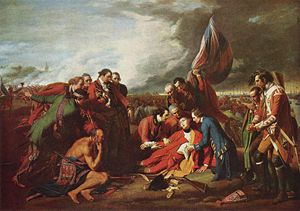
The Death of Full general Wolfe by Benjamin Westward
England's American empire was slowly expanded by war and colonization, England gaining control of New Amsterdam (later on New York) via negotiations following the Second Anglo-Dutch State of war. The growing American colonies pressed ever w in search of new agricultural lands.
During the 7 Years' War the British defeated the French at the Plains of Abraham and captured all of New France in 1760, giving Uk command over the greater part of Northward America.
Later, settlement of Australia (starting with penal colonies from 1788) and New Zealand (under the crown from 1840) created a major zone of British migration. The unabridged Australian continent was claimed for Britain when Matthew Flinders (1774-1814) proved New Holland and New South Wales to be a single land mass past completing a circumnavigation of it in 1803. The colonies later became self-governing colonies and became assisting exporters of wool and gold.
Free trade and "informal empire"
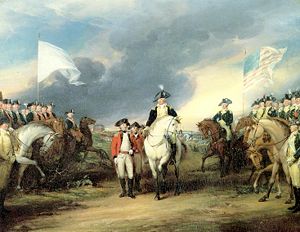
Give up of Cornwallis at Yorktown (John Trumbull, 1797). The loss of the American colonies marked the end of the "outset British Empire."
The old British colonial system began to pass up in the eighteenth century. During the long period of unbroken Whig dominance of domestic political life (1714–1762), the empire became less important and less well-regarded, until an ill-blighted attempt (largely involving taxes, monopolies, and zoning) to opposite the resulting "salutary neglect" (or "benign neglect") provoked the American Revolutionary War (1775–1783), depriving the empire of its almost populous colonies.
The period is sometimes referred to equally the end of the "beginning British Empire," indicating the shift of British expansion from the Americas in the seventeenth and eighteenth centuries to the "second British Empire" in Asia and afterwards too Africa from the eighteenth century. The loss of the Thirteen Colonies showed that colonies were non necessarily particularly beneficial in economic terms, since Uk could still profit from merchandise with the ex-colonies without having to pay for their defense and administration.
Mercantilism, the economic doctrine of competition between nations for a finite corporeality of wealth which had characterized the get-go period of colonial expansion, now gave way in Britain and elsewhere to the laissez-faire economic classical liberalism of Adam Smith and successors like Richard Cobden (1804-1865) a manufacturer, politician and anti-regulationist.
The lesson of United kingdom's North American loss—that trade might be profitable in the absence of colonial dominion—contributed to the extension in the 1840s and 1850s of self-governing colony status to white settler colonies in Canada and Australasia whose British or European inhabitants were seen as outposts of the "mother country." Ireland was treated differently considering of its geographic proximity, and incorporated into the United Kingdom of United kingdom and Ireland in 1801; due largely to the impact of the Irish Rebellion of 1798 against British dominion.
During this period, Britain besides outlawed the slave trade (1807) and before long began enforcing this principle on other nations. Past the mid-nineteenth-century Britain had largely eradicated the world slave trade. Slavery itself was abolished in the British colonies in 1834, though the phenomenon of indentured labor retained much of its oppressive character until 1920.
The cease of the old colonial and slave systems was accompanied by the adoption of free trade, culminating in the repeal of the Corn Laws and Navigation Acts (regulatory measures) in the 1840s. Free merchandise opened the British market to unfettered competition, stimulating reciprocal action by other countries during the heart quarters of the nineteenth century.
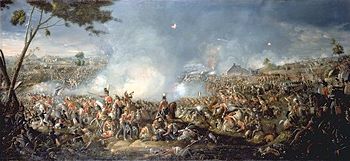
The Boxing of Waterloo marked the finish of the Napoleonic Wars and the first of the Pax Britannica
Some argue that the rise of free trade merely reflected Britain's economic position and was unconnected with any true philosophical conviction. Despite the earlier loss of 13 of Britain's North American colonies, the final defeat in Europe of Napoleonic France in 1815 left Uk the most successful international power. While the Industrial Revolution at habitation gave Britain an unrivaled economic leadership, the Imperial Navy dominated the seas. The distraction of rival powers past European matters enabled U.k. to pursue a phase of expansion of its economic and political influence through "informal empire" underpinned by free merchandise and strategic pre-eminence.
Between the Congress of Vienna of 1815 and the Franco-Prussian War of 1870, Britain was the world'southward sole industrialized ability, with over 30 percent of the global industrial output in 1870. Equally the "workshop of the world," United kingdom could produce finished manufactures so efficiently and cheaply that they could undersell comparable locally produced goods in foreign markets. Given stable political atmospheric condition in particular overseas markets, Britain could prosper through free trade lonely without having to resort to formal rule. The Americas in particular (especially in Argentina and the United States) were seen as being well nether the breezy British trade empire due to Britain's enforcement of the Monroe Doctrine, keeping other European nations from establishing formal rule in the area. Nevertheless, free trade appears to have become imperial policy, since Uk institute information technology convenient in many parts of the earth to engage in trade and to negotiate trading rights without formally acquiring sovereignty, every bit in Communist china, Iran, and the Gulf States. This went manus-in-hand with the belief that Britain at present had a duty to police the earth—that is, to protect trade. The term Pax Britannica was later used to depict this period, drawing an obvious parallel with the Pax Romana. Behind this term lies the thought that this type of imperial system benefits the ruled also as the rulers.
British Eastward India Company
The British East Bharat Company was probably the well-nigh successful chapter in the British Empire'southward history as information technology was responsible for the annexation of the Indian subcontinent, which would become the empire's largest source of revenue, along with the conquest of Hong Kong, Singapore, Ceylon, Malaya (which was also i of the largest sources of revenue) and other surrounding Asian countries, and was thus responsible for establishing United kingdom of great britain and northern ireland's Asian empire, the most important component of the British Empire.
The British East India Visitor originally began as a joint-stock company of traders and investors based in Leadenhall Street, London, which was granted a Royal Lease by Elizabeth I in 1600, with the intent to favor trade privileges in Republic of india. The Purple Charter effectively gave the newly created "Honourable East Republic of india Visitor" a monopoly on all merchandise with the East Indies. The company transformed from a commercial trading venture to i which virtually ruled India as it acquired auxiliary governmental and war machine functions, along with a very big private army consisting of local Indian sepoys (soldiers), who were loyal to their British commanders and were probably the most important cistron in Britain's Asian conquest. The British East Republic of india Company is regarded by some as the world'southward start multinational corporation. Its territorial holdings were subsumed past the British crown in 1858, in the aftermath of the events variously referred to every bit the Sepoy Rebellion or the Indian Mutiny.
At that time in that location was no political entity called India. The Indian subcontinent was a patchwork of many kingdoms, and unlike in Europe there was no concept of the state as a political institution anywhere in this expanse of land. Information technology was indeed with the absorption of British and western ideas that the concept of India as a single nation arose, much later in time. Thus, until the establishment of a single authoritative and gubernatorial entity past the British, the word Republic of india must exist taken to stand for nothing more a catchall term for the peninsula south of the Himalayas.
The company as well had interests along the routes to Bharat from Corking Uk. As early on every bit 1620, the company attempted to lay claim to the Tabular array Mount region in Due south Africa, afterwards it occupied and ruled the island of Saint Helena. The visitor likewise established Hong Kong and Singapore; and cultivated the production of tea in India. Other notable events in the company'south history were that it held Napoleon convict on Saint Helena, and fabricated the fortune of Elihu Yale (1649-1721) the benefactor of Yale College, Boston. Its products were the basis of the Boston Tea Political party in Colonial America.
In 1615 Sir Thomas Roe was instructed by James I to visit the Mughal emperor Jahangir (who ruled over most of the Indian subcontinent at the fourth dimension, forth with parts of Afghanistan). The purpose of this mission was to adjust for a commercial treaty which would requite the company exclusive rights to reside and build factories in Surat and other areas. In return, the visitor offered to provide to the emperor goods and rarities from the European marketplace. This mission was highly successful and Jahangir sent a letter to the rex through Roe. As a result, The British East Republic of india Company institute itself completely dominant over the French, Dutch and Portuguese trading companies in the Indian subcontinent.
In 1634 the Mughal emperor Shah Jahan extended his hospitality to the English traders to the region of Bengal, which had the globe'south largest textile manufacture at the time. In 1717 the Mughal Emperor at the time completely waived customs duties for the merchandise, giving the company a decided commercial advantage in the Indian trade. With the visitor'southward large revenues, it raised its ain armed forces from the 1680s, mainly drawn from the indigenous local population, who were Indian sepoys under the control of British officers.
Expansion
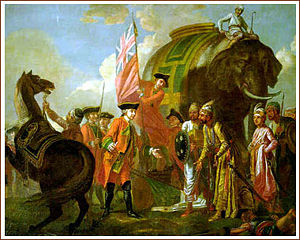
Robert Clive's victory at the Battle of Plassey established the visitor as a military besides equally commercial power
The decline of the Mughal Empire, which had separated into many smaller states controlled past local rulers who were ofttimes in conflict with ane another, immune the company to expand its territories, which began in 1757 when the visitor came into conflict with the Nawab of Bengal, Siraj Ud Daulah. Under the leadership of Robert Clive, the company troops and their local allies defeated the Nawab on June 23, 1757, at the Boxing of Plassey. The victory was mostly due to the treachery of the Nawab's former ground forces chief, Mir Jafar. This victory, which resulted in the conquest of Bengal, established the British East India Company as a military as well as a commercial power, and marked the beginning of British rule in India. The wealth gained from the Bengal treasury immune the company to significantly strengthen its armed services might and as a result, extend its territories, conquering most parts of India with the massive Indian ground forces it had acquired.
The company fought many wars with local Indian rulers during its conquest of India, the near difficult beingness the 4 Anglo-Mysore Wars (between 1766 and 1799) confronting the South Indian Kingdom of Mysore, ruled past Hyder Ali, and later his son Tipu Sultan (The Tiger of Mysore). There were a number of other states which the company couldn't conquer through armed forces might, generally in the North, where the visitor's presence was ever increasing amid the internal conflict and dubious offers of protection against one some other. Coercive activeness, threats and affairs aided the company in preventing the local rulers from putting up a united struggle against it. By the 1850s the visitor ruled over most of the Indian subcontinent, and as a issue, began to function more equally a nation and less as a trading concern.
The company was also responsible for the illegal opium trade with China against the Qing Emperor's will, which later led to the ii Opium Wars (between 1834 and 1860). Every bit a event of the company's victory in the Showtime Opium War, information technology established Hong Kong. The company besides had a number of wars with other surrounding Asian countries, the virtually difficult probably being the three Anglo-Afghan Wars (between 1839 and 1919) against Transitional islamic state of afghanistan, which were mostly unsuccessful.
Collapse
The company's rule finer came to an terminate exactly a century after its victory at Plassey, when the anti-British rebellion bankrupt out in 1857 which saw many of the Company's Indian sepoys begin an armed uprising confronting their British commanders afterward a menstruation of political unrest triggered by a number of political events. One of the major factors was the company's introduction of the Pattern 1853 Enfield rifle. The paper cartridges containing the gunpowder were lubricated with creature fat, and had to be bitten open before the powder was poured into the muzzle. Eating cow fat was forbidden for the Hindu soldiers, while hog fat was forbidden for the Muslim soldiers. Although information technology insisted that neither cow fat nor pig fat was existence used, the rumor persisted and many sepoys refused to follow their orders and employ the weapons. Another factor was the execution of the Indian sepoy Mangal Pandey, who was hanged for attacking and injuring his British superiors, possibly out of insult for the introduction of the Pattern 1853 Enfield burglarize or a number of other reasons. Combined with the policy of annexing Princely states this resulted in the rebellion, which eventually brought about the terminate of the British East India Company's regime in Republic of india, and instead led to 90 years of direct dominion of the Indian subcontinent by Britain. The menses of direct British rule in Bharat is known equally the British Raj, when the regions at present known as Bharat, Islamic republic of pakistan, People's republic of bangladesh, and Myanmar would collectively be known as British India.
Breakup of Pax Britannica
Equally the offset country to industrialize, Britain had been able to draw on nearly of the accessible world for raw materials and markets. But this situation gradually deteriorated during the nineteenth century as other powers began to industrialize and sought to use the land to guarantee their markets and sources of supply. By the 1870s, British articles in the staple industries of the Industrial Revolution were starting time to feel real competition abroad.
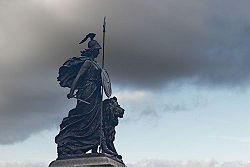
Britannia became a symbol of United kingdom's regal might
Industrialization progressed rapidly in Frg and the United States, allowing them to overtake the "old" British and French economies as globe leader in some areas. Past 1870 the High german material and metal industries had surpassed those of Britain in organization and technical efficiency and usurped British manufactures in the domestic market. By the turn of the century, the German metals and engineering industries would even be producing for the costless trade marketplace of the onetime "workshop of the world."
While invisible exports (banking, insurance and shipping services) kept U.k. "out of the red," her share of globe merchandise fell from a quarter in 1880 to a sixth in 1913. Britain was losing out not only in the markets of newly industrializing countries, merely also against third-party competition in less-developed countries. Britain was even losing her former overwhelming dominance in merchandise with Republic of india, Cathay, Latin America, or the coasts of Africa.
United kingdom of great britain and northern ireland'due south commercial difficulties deepened with the onset of the "Long Depression" of 1873-1896, a prolonged catamenia of toll deflation punctuated by astringent business organization downturns which added to pressure on governments to promote habitation industry, leading to the widespread abandonment of free trade among Europe's powers (Germany from 1879 and French republic from 1881).
The resulting limitation of both domestic markets and consign opportunities led government and concern leaders in Europe and after the U.S. to see the solution in sheltered overseas markets united to the home country behind imperial tariff barriers. New overseas subjects would provide export markets costless of foreign competition, while supplying inexpensive raw materials. Although it continued to adhere to gratuitous merchandise until 1932, Britain joined the renewed scramble for formal empire rather than allow areas under its influence to be seized by rivals.
Britain and the New Imperialism
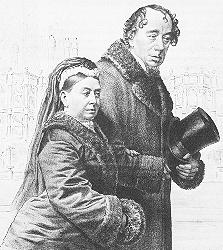
The policy and ideology of European colonial expansion between the 1870s and the outbreak of World War I in 1914 are frequently characterized every bit the "New Imperialism." The period is distinguished by an unprecedented pursuit of what has been termed "empire for empire's sake," aggressive contest for overseas territorial acquisitions and the emergence in colonizing countries on the footing of doctrines of racial superiority that denied the fitness of subjugated peoples for cocky-government.
During this period, Europe's powers added nearly nine one thousand thousand square miles (23,000,000 square kilometers) to their overseas colonial possessions. Every bit it was generally unoccupied by the Western powers every bit tardily as the 1880s, Africa became the primary target of the "new" imperialist expansion, although conquest took place also in other areas—notably Southeast Asia and the East Asian seaboard, where Japan joined the European powers' scramble for territory.
Britain's entry into the new regal age is ofttimes dated to 1875, when the Bourgeois government of Benjamin Disraeli bought the indebted Egyptian ruler Ismail's shareholding in the Suez Canal to secure control of this strategic waterway, a channel for aircraft betwixt Great britain and India since its opening 6 years earlier under Emperor Napoleon III of France. Articulation Anglo-French fiscal control over Egypt ended in outright British occupation in 1882.
Fear of Russia's centuries-old s expansion was a further factor in British policy. In 1878 Britain took control of Cyprus as a base for action against a Russian attack on the Ottoman Empire, after having taken role in the Crimean State of war (1854–1856) and invading Afghanistan to preclude an increase in Russian influence there. Britain waged three bloody and unsuccessful wars in Transitional islamic state of afghanistan as ferocious popular rebellions, invocations of jihad, and inscrutable terrain frustrated British objectives. The First Anglo-Afghan War led to one of the most disastrous defeats of the Victorian military, when an entire British army was wiped out by Russian-supplied Afghan Pashtun tribesmen during the 1842 retreat from Kabul. The Second Anglo-Afghan State of war led to the British debacle at Maiwand in 1880, the siege of Kabul, and British withdrawal into India. The Third Anglo-Afghan State of war of 1919 stoked a tribal uprising confronting the wearied British military on the heels of World War I and expelled the British permanently from the new Afghan land. The "Peachy Game"—espionage and counter-espionage peculiarly with reference to Russia's interests in the region—in Inner Asia ended with a bloody British expedition against Tibet in 1903–1904. Rudyard Kipling's novel, Kim (1901) is gear up in the context of the "Groovy Game," a term get-go coined past Arthur Conolly (1807-1842), a British regular army and intelligence officeholder.
At the same time, some powerful industrial lobbies and government leaders in Britain, later exemplified past Joseph Chamberlain, came to view formal empire as necessary to arrest Britain's relative reject in earth markets. During the 1890s, Britain adopted the new policy wholeheartedly, quickly emerging as the forepart-runner in the scramble for tropical African territories.
United kingdom's adoption of the New Imperialism may be seen every bit a quest for captive markets or fields for investment of surplus uppercase, or as a primarily strategic or pre-emptive attempt to protect existing merchandise links and to prevent the absorption of overseas markets into the increasingly closed majestic trading blocs of rival powers. The failure in the 1900s of Chamberlain's Tariff Reform campaign for Imperial protection illustrates the strength of free trade feeling fifty-fifty in the confront of loss of international marketplace share. Historians have argued that Britain's adoption of the "New imperialism" was an issue of her relative decline in the world, rather than of strength.
British colonial policy
British colonial policy was ever driven to a large extent by Great britain's trading interests. While settler economies developed the infrastructure to support balanced evolution, some tropical African territories establish themselves developed only as raw-fabric suppliers. British policies based on comparative advantage left many developing economies dangerously reliant on a single greenbacks crop, with others exported to Britain or to overseas British settlements. A reliance upon the manipulation of conflict between ethnic, religious and racial identities in order to keep subject populations from uniting against the occupying power—the classic "dissever and rule" strategy—left a legacy of partition and/or inter-communal difficulties in areas as diverse as Ireland, India, Zimbabwe, Sudan, and Republic of uganda, though in all cases these societies were plagued with internal division well earlier British dominion. Rudyard Kipling (1865-1936), winner of the 1907 Noble Prize for Literature, in his 1899 poem, "The White Human's Burden," expressed what many—especially during the reign of Queen Victoria—represented the raison d'etre of empire: that it was a moral responsibility to dominion over people who were 'one-half-devil and half child' who therefore needed the subject, oversight and governance that only a superior race could provide. Some saw the chore of Christianizing and civilizing imperial subjects as part and parcel of the same job. Victoria, though, was less cracking on extensive missions, just in many parts of the empire evangelical colonial officers gave their total support to the missionaries in their areas.
Britain and the scramble for Africa

In 1875 the 2 nearly of import European holdings in Africa were French-controlled Algeria and United kingdom'due south Cape Colony. By 1914 but Ethiopia and the republic of Liberia remained outside formal European control. The transition from an "informal empire" of control through economic dominance to straight command took the class of a "scramble" for territory by the nations of Europe. Uk tried not to play a part in this early scramble, existence more than of a trading empire rather than a colonial empire; however, it soon became clear it had to gain its own African empire to maintain the residuum of power.
As French, Belgian and Portuguese activity in the lower Congo River region threatened to undermine orderly penetration of tropical Africa, the Berlin Briefing of 1884-85 sought to regulate the competition betwixt the powers by defining "constructive occupation" every bit the criterion for international recognition of territorial claims, a formulation which necessitated routine recourse to armed forcefulness against indigenous states and peoples.
U.k.'s 1882 military occupation of Arab republic of egypt (itself triggered by business concern over the Suez Culvert) contributed to a preoccupation over securing control of the Nile valley, leading to the conquest of the neighboring Sudan in 1896–98 and confrontation with a French armed services expedition at Fashoda (September 1898).
In 1899 Britain completed its takeover of what is today South Africa. This had begun with the annexation of the Cape in 1795 and continued with the conquest of the Boer Republics in the late nineteenth century, following the 2d Boer War. Cecil Rhodes was the pioneer of British expansion n into Africa with his privately owned British Southward Africa Company. Rhodes expanded into the state north of South Africa and established Rhodesia. Rhodes' dream of a railway connecting Cape Town to Alexandria passing through a British Africa roofing the continent is what led to his company's pressure on the authorities for further expansion into Africa.
British gains in southern and East Africa prompted Rhodes and Alfred Milner, 1st Viscount Milner, Britain's High Commissioner in South Africa, to urge a "Cape-to-Cairo" empire linking by track the strategically of import Suez Canal to the mineral-rich South, though German occupation of Tanganyika prevented its realization until the end of Earth War I. In 1903 the All Red Line telegraph system communicated with the major parts of the Empire.
Paradoxically, Britain—the staunch abet of gratuitous trade—emerged in 1914 with not simply the largest overseas empire thanks to her long-standing presence in Republic of india, but also the greatest gains in the "scramble for Africa," reflecting her advantageous position at its inception. Between 1885 and 1914 United kingdom of great britain and northern ireland took nearly thirty percent of Africa'due south population nether her control, compared to xv percent for France, 9 percent for Frg, vii percent for Belgium and 1 percentage for Italy. Nigeria lone contributed fifteen million subjects, more than in the whole of French W Africa or the entire German colonial empire.
Dwelling rule in white-settler colonies
Britain'due south empire had already begun its transformation into the modern Commonwealth with the extension of dominion status to the already self-governing colonies of Canada (1867), Commonwealth of australia (1901), New Zealand (1907), Newfoundland (1907), and the newly-created Marriage of Southward Africa (1910). Leaders of the new states joined with British statesmen in periodic Colonial (from 1907, Imperial) Conferences, the first of which was held in London in 1887.
The foreign relations of the dominions were yet conducted through the Foreign Office of the United Kingdom: Canada created a Department of External Affairs in 1909, only diplomatic relations with other governments continued to be channeled through the Governors-General, Dominion High Commissioners in London (first appointed past Canada in 1880 and by Australia in 1910) and British legations away. Britain'southward declaration of state of war in World War I applied to all the dominions.
The dominions enjoyed substantial freedom in their adoption of foreign policy where this did non explicitly conflict with British interests: Canada'due south Liberal government negotiated a bilateral gratuitous-trade Reciprocity Agreement with the U.s.a. in 1911, just went downwardly to defeat by the Conservative opposition.
In defense, the dominions' original treatment equally function of a single imperial military and naval construction proved unsustainable equally Great britain faced new commitments in Europe and the challenge of an emerging German High Seas Armada later 1900. In 1909 it was decided that the dominions should take their own navies, reversing an 1887 agreement that the and so Australasian colonies should contribute to the Imperial Navy in return for the permanent stationing of a squadron in the region.
The impact of the First World War
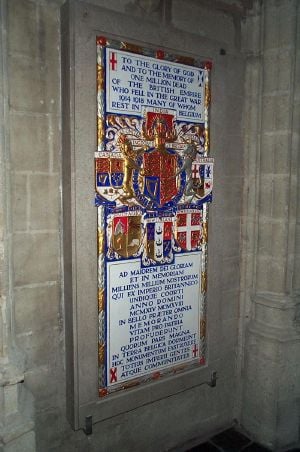
British Empire memorial for the First World State of war in the Brussels cathedral
The aftermath of World War I saw the last major extension of British rule, with United kingdom of great britain and northern ireland gaining control through League of Nations Mandates in Palestine and Iraq after the plummet of the Ottoman Empire in the Center Eastward, as well as in the erstwhile German colonies of Tanganyika, South-West Africa (now Namibia) and New Guinea (the last two really under South African and Australian rule respectively). Britain's Palestine Mandate, inspired past the Balfour Proclamation of 1917, committed Britain to establishing a Jewish homeland in Palestine. This was only half-heartedly implemented due to the opposition of Palestinian Arabs and attacks by Jewish terrorist gangs. There is little incertitude, though, that many involved in acquiring the Mandate of Palestine, including General Edmund Allenby (1861-1936) idea that Uk had a special role to play in the Middle East, maybe as God'due south agent in the restoration of Israel. Thus, Great britain's war-time interest in the Heart East had, for many, a Biblical dimension (Phillips, 256).
The British zones of occupation in the German Rhineland after World War I and West Deutschland later on Globe War II were not considered part of the empire.
Although U.k. emerged among the war'southward victors and the empire's rule expanded into new areas, the heavy costs of the war undermined her chapters to maintain the vast empire. The British had suffered millions of casualties and liquidated assets at an alarming charge per unit, which led to debt aggregating, upending of upper-case letter markets and manpower deficiencies in the staffing of far-flung regal posts in Asia and the African colonies. Nationalist sentiment grew in both onetime and new Imperial territories, fueled by pride at imperial troops' participation in the war and the grievance felt by many non-white ex-servicemen at the racial bigotry they had encountered during their service to the empire.
The 1920s saw a rapid transformation of dominion condition. Although the dominions had no formal phonation in declaring war in 1914, each was included separately among the signatories of the 1919 peace Treaty of Versailles, which had been negotiated past a British-led united empire delegation. In 1922 dominion reluctance to support British war machine activeness confronting Turkey influenced United kingdom of great britain and northern ireland's decision to seek a compromise settlement.
The Balfour Annunciation of 1926 provided the Dominions the right to exist considered equal to Great britain, rather than subordinate; an agreement that had the result of a shared Crown that operates independently in each realm rather than a unitary British Crown under which all the Dominions were secondary. The monarchy thus ceased to be an exclusively British institution, although it has often been chosen British since this time (in both legal and common language) for reasons historical, political, and of convenience. The Royal and Parliamentary Titles Act, 1927 was the first indication of this shift in law, further elaborated in the Statute of Westminster, 1931. Each dominion was henceforth to be equal in status to United kingdom of great britain and northern ireland herself, complimentary of British legislative interference and autonomous in international relations. The dominions section created within the Colonial Role in 1907 was upgraded in 1925 to a separate Dominions Office and given its own secretarial assistant of land in 1930.
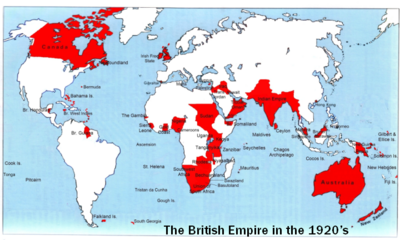
Map showing British Empire in the 1920s, colored red
Canada led the manner, becoming the first dominion to conclude an international treaty entirely independently (1923) and obtaining the appointment (1928) of a British High Commissioner in Ottawa, thereby separating the administrative and diplomatic functions of the governor-general and ending the latter's anomalous role as the representative of the head of state and of the British Government. Canada'south first permanent diplomatic mission to a foreign state opened in Washington, D.C. in 1927. Australia followed in 1940.
Egypt, formally independent from 1922 but bound to United kingdom of great britain and northern ireland by treaty until 1936 (and nether partial occupation until 1956), similarly severed all constitutional links with Britain. Iraq, which became a British Protectorate in 1922, also gained consummate independence 10 years later in 1932.
The finish of British rule in Ireland
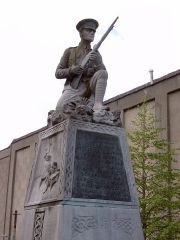
An Anglo-Irish War memorial in Dublin
Despite Irish dwelling rule (simply not Irish ramble independence) being guaranteed nether the Third Irish Home Rule Act in 1914, the onset of Earth War I delayed its implementation. On Easter Monday 1916, an initially unsuccessful armed uprising was staged in Dublin by a mixed group of nationalists, including Michael Collins. After his release from prison in 1919, Collins led Irish guerrillas, known as the Irish Republican Army in a military machine campaign against British rule. The ensuing Anglo-Irish War concluded in 1921 with a stalemate and the signing of the Anglo-Irish gaelic Treaty. The treaty divided Ireland into two states, most of the isle (26 counties) became the Irish Gratis State, an independent dominion nation within the Commonwealth of Nations, while the six counties in the due north with a largely loyalist, Protestant community remained a function of the United Kingdom as Northern Ireland.
In 1948 Ireland became a republic, fully independent from the United Kingdom, and withdrew from the Commonwealth. Ireland's Constitution claimed the six counties of Northern Ireland as a role of the Democracy of Ireland until 1998. The issue over whether Northern Ireland should remain in the United Kingdom or join the Republic of Ireland has divided Northern Ireland'south people and led to a long and bloody conflict between republicans (Catholic) and loyalists (or Unionists)(Protestant) known as "the Troubles." Nonetheless, the Good Fri Agreement of 1998 brought about a ceasefire between most of the major organizations on both sides, creating hope for a peaceful resolution.
Decolonization and refuse
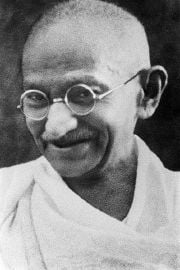
Mahatma Gandhi, ane of the leaders of the Indian independence motion
The ascent of anti-colonial nationalist movements in the field of study territories and the changing economic situation of the world in the first half of the twentieth century challenged an imperial power now increasingly preoccupied with issues nearer home.
The empire'south terminate began with the onset of the Second World War. When the Japanese captured Singapore in 1942 it showed the colonies that the British Empire was not invincible and that it would exist impossible for the condition quo to exist restored subsequently the finish of the war. A deal was reached between the British government and the Indian independence movement, whereby the Indians would cooperate and remain loyal during the war, afterwards which they would exist granted independence. Following India'southward pb, almost all of Britain's other colonies would become contained over the side by side two decades.
The terminate of empire gathered pace later on U.k.'south efforts during World War II left the country all but exhausted and found its former allies disinclined to support the colonial status quo. Economic crisis in 1947 fabricated many realize that the Labour regime of Clement Attlee should abandon United kingdom of great britain and northern ireland's attempt to retain all of its overseas territories. The empire was increasingly regarded as an unnecessary drain on public finances by politicians and civil servants, if not the general public.
Britain'south declaration of hostilities against Germany in September 1939 did not automatically commit the dominions. All the dominions except Commonwealth of australia and Ireland issued their own declarations of state of war. The Irish Free Country had negotiated the removal of the Regal Navy from the Treaty Ports the yr before, and chose to remain legally neutral throughout the war. Australia went to war under the British declaration.
World War II fatally undermined Britain's already weakened commercial and financial leadership and heightened the importance of the dominions and the U.s. as a source of war machine assistance. Australian prime minister John Curtin'south unprecedented action (1942) in successfully demanding the call up for home service of Australian troops earmarked for the defence force of British-held Burma demonstrated that dominion governments could no longer be expected to subordinate their own national interests to British strategic perspectives. Curtin had written in a national newspaper the twelvemonth earlier that Australia should look to the United States for protection rather than Britain.
After the state of war, Australia and New Zealand joined with the United States in the ANZUS (Australia, New Zealand, United States) regional security treaty in 1951 (although the U.S. repudiated its commitments to New Zealand following a 1985 dispute over port access for nuclear vessels). Britain'southward pursuit (from 1961) and attainment (1973) of European Community membership weakened the old commercial ties to the dominions, ending their privileged access to the UK market.
In the Caribbean, Africa, Asia and the Pacific, post-war decolonization was accomplished with almost unseemly haste in the face of increasingly powerful (and sometimes mutually conflicting) nationalist movements, with Britain rarely fighting to retain whatever territory. Britain's limitations were exposed to a humiliating degree by the Suez Crisis of 1956 in which the U.s. opposed British, French and Israeli intervention in Egypt, seeing it as a doomed adventure likely to jeopardize American interests in the Middle Eastward.
The independence of Republic of india in 1947 ended a forty-year struggle past the Indian National Congress, firstly for self-authorities and later for full sovereignty, though the land's partition into India and Pakistan entailed violence costing hundreds of thousands of lives. The acceptance by Britain, and the other dominions, of India's adoption of republican status (1950) is now taken as the start of the modern Commonwealth.
Singapore became independent in ii stages. The British did not believe that Singapore would be large enough to defend itself against others lone. Therefore, Singapore was joined with Malaya, Sarawak and North Borneo to course Malaysia upon independence from the Empire. This short-lived union was dissolved in 1965 when Singapore left Malaysia and achieved consummate independence.
Burma accomplished independence (1948) outside the Democracy; Burma being the first colony to sever all ties with the British; Ceylon (1948) and Malaya (1957) within it. Uk's Palestine Mandate concluded (1948) in withdrawal and open up warfare between the territory's Jewish and Arab populations. In the Mediterranean, a guerrilla state of war waged by Greek Cypriot advocates of wedlock with Hellenic republic ended (1960) in an independent Republic of cyprus, although Britain did retain 2 armed services bases—Akrotiri and Dhekelia.
The terminate of Great britain's empire in Africa came with exceptional rapidity, often leaving the newly-contained states sick-equipped to deal with the challenges of sovereignty: Ghana's independence (1957) after a ten-year nationalist political campaign was followed by that of Nigeria and Somaliland (1960), Sierra Leone and Tanganyika (1961), Uganda (1962), Kenya and Zanzibar (1963), Gambia (1965), Botswana (formerly Bechuanaland) and Kingdom of lesotho (formerly Basutoland) (1966) and Swaziland (1968).
British withdrawal from the southern and eastern parts of Africa was complicated past the region's white settler populations: Republic of kenya had already provided an example in the Mau Mau Insurgence of fierce conflict exacerbated by white landownership and reluctance to concede majority rule. White minority rule in South Africa remained a source of bitterness inside the Commonwealth until the Union of South Africa left the Republic in 1961.
Although the white-dominated Federation of Rhodesia and Nyasaland ended in the independence of Malawi (formerly Nyasaland) and Zambia (the former Northern Rhodesia) in 1964, Southern Rhodesia's white minority (a self-governing colony since 1923) declared independence with their Unilateral Declaration of Independence rather than submit to equality with black Africans. The support of South Africa's apartheid authorities kept the Rhodesian regime in place until 1979, when agreement was reached on bulk rule in an independent Zimbabwe.
Most of Britain's Caribbean territories opted for eventual split up independence after the failure of the Westward Indies Federation (1958–1962): Jamaica and Trinidad and Tobago (1962) were followed into statehood past Barbados (1966) and the smaller islands of the eastern Caribbean (1970s and 1980s). Great britain'due south Pacific dependencies such every bit the Gilbert Islands (which had seen the last attempt at human colonization inside the Empire—the Phoenix Islands Settlement Scheme) underwent a similar process of decolonization in the latter decades.
Every bit decolonization and the Common cold State of war were gathering momentum during the 1950s, an uninhabited rock in the Atlantic Body of water, Rockall, became the concluding territorial acquisition of the Uk. Concerns that the Soviet Spousal relationship might use the isle to spy on a British missile test prompted the Majestic Navy to country a party and officially merits the rock in the name of the Queen in 1955. In 1972 the Island of Rockall Deed formally incorporated the isle into the United Kingdom.
In 1982, Great britain'due south resolve to defend her remaining overseas territories was put to the test when Argentine republic invaded the Falkland Islands, acting on a long-standing merits that dated back to the Spanish Empire. Britain's ultimately successful military response to liberate the islands during the ensuing Falklands War prompted headlines in the U.Southward. press that "the Empire strikes back," and was viewed past many to accept contributed to reversing the downward trend in the UK'southward status as a world power.[ii]
In 1997 Britain's terminal major overseas territory, Hong Kong, became a Special Administrative Region of the People's Republic of China under the terms of the Sino-British Joint Declaration agreed some xiii years prior. The remaining British overseas territories, the Commonwealth of Nations and the enduring personal unions with the Commonwealth Realms establish the legacy of the British Empire.
While it is definitely true to say that a reason for the dissolution of the British Empire was that U.k. was in no state, financially or militarily, to defend or continue together her empire, it must also be noted that Cold State of war politics also played their role, especially with regard to Britain's African possessions. The United States and the Soviet Union were competing for international favor, and due to the full general global liberalism in the world in the wake of the Second World War, imperialism became unfashionable. The U.Southward. and the Soviet Union, anxious to win allies and commercial opportunities, apace gave back up to nationalists in the colonies to appear to be bankroll 'freedom' as opposed to the 'repression' of imperial rule. It is also said that every bit part of America'south understanding to join in the Second World War was a demand that the European Powers (mostly Uk, but it is important to retrieve that France still owned a large empire) give up their imperial possessions. Phillips (2005) argues that United kingdom of great britain and northern ireland also failed to modernize her industrial base, which was built on coal. While Britain had led the Industrial Revolution, it had continued to rely on its existing applied science, rather than continue to innovate. British inventions, too, had mainly been by "skilled craftsmen and engineers, not men of science" (fifteen) and these were mainly employed by pocket-size, family unit-run firms. Thus, Britain failed to develop the "research laboratories [backed by large-scale] iron and steel enterprises," dissimilar Germany and the U.Due south. Britain besides realized too late that oil was replacing coal as the primary source of energy.
Legacy
The legacy of the British Empire includes many stable democracies, often modeled on the Westminster Parliament. English Common law remains the basis of legal systems throughout the former colonies. Schools, colleges, and universities founded by the British take developed into institutions of excellence. Protestantism, with its accompanying secular values such as the dignity and rights of the individual, has been planted widely. The many railways that were constructed improved communications and enabled people to develop a sense of national identity likewise every bit a feeling of belonging to the wider civilized earth. English remains a lingua franca, often popular even where it is not an official linguistic communication (as in India). The greatest legacy is probably the Republic of Nations a voluntary clan of 53 erstwhile colonies who desire to maintain close ties with U.k. and with each other. The head of the Democracy is the Queen. She is nevertheless the Head of State of sixteen Commonwealth realms such as Canada, Australia, and Barbados.
See also
- Commonwealth of Nations
- British East India Company
Notes
- ↑ Adams, James Truslow. "On the Term 'British Empire." American Historical Review 22 (1927), 485–489; Armitage 174-175.
- ↑ Lawrence James, The Rising and Fall of the British Empire (New York, NY: St. Martin'due south Griffin, 1997, ISBN 031216985X), 629.
References
ISBN links support NWE through referral fees
Overviews
- Bryant, Arthur. The History of Britain and the British Peoples. 3 vols. London: Collins, 1984–1990. ISBN 000217412X
- Ferguson, Niall. Empire: The Rise and Demise of the British World Order and the Lessons for Global Powers. New York: Basic Books, 2003. ISBN 0465023282
- Hyam, Ronald. United kingdom'south Imperial Century, 1815-1914: A Study of Empire and Expansion. Houndmills, Basingstoke, Hampshire; New York: Palgrave/Macmillan, 2002. ISBN 033399311X
- James, Lawrence. The Rise and Fall of the British Empire. New York: St. Martin'southward Printing, 1997. ISBN 031216985X
- Judd, Denis. Empire: The British Imperial Experience, From 1765 to the Present. New York: Basic Books, 1996. ISBN 0465019528
- Lloyd, Trevor Owen. The British Empire, 1558-1995. Oxford and New York: Oxford University Printing, 1996. ISBN 0198731337
- Louis, William. Roger (ed.). The Oxford History of the British Empire. 5 vols. Oxford and New York: Oxford University Press, 1998-1999. ISBN 0198205627 (v. 1); ISBN 0198205635 (v. two); ISBN 0198205651 (v. iii); ISBN 0198205643 (v. iv); ISBN 019820566X (5. 5).
- Marshall, Peter James (ed.). The Cambridge Illustrated History of the British Empire. Cambridge and New York: Cambridge University Press, 1996. ISBN 0521432111
- Olson, James S. and Robert S. Shadle. Historical Dictionary of the British Empire. Westport, CT: Greenwood Press, 1996. ISBN 0313279179
- Rose, J. Kingdom of the netherlands, A. P. Newton and E. A. Benians (eds.). The Cambridge History of the British Empire. 9 vols. Cambridge: The Cambridge Academy Press, 1929–1961.
- Smith, Simon C. British Imperialism 1750-1970. Cambridge and New York: Cambridge University Press, 1998. ISBN 052159930X
Specialized scholarly studies
- Andrews, Kenneth R. Trade, Plunder and Settlement: Maritime Enterprise and the Genesis of the British Empire 1480–1630. Cambridge: Cambridge Academy Press, 1984. ISBN 0521276985
- Armitage, David. The Ideological Origins of the British Empire. Cambridge: Cambridge University Press, 2000. ISBN 0521789788
- Armitage, David. "Greater Britain: A Useful Category of Historical Analysis?" American Historical Review 104 (1999): 427–445.
- Armitage, David (ed.). Theories of Empire, 1450–1800. Aldershot: Ashgate Publishing, 1998. ISBN 0860785165
- Barone, Charles A. Marxist Thought on Imperialism: Survey and Critique. London: Macmillan, 1985. ISBN 0873322916
- Bailyn, Bernard and Philip D. Morgan (eds.). Strangers within the Realm: Cultural Margins of the Beginning British Empire. Chapel Hill, NC: Academy of Due north Carolina, 1991. ISBN 0807843113
- Barker, Sir Ernest. The Ideas and Ideals of the British Empire. Cambridge: Cambridge University Printing, 1941.
- Baumgart, Winfried. Imperialism: The Idea and Reality of British and French Colonial Expansion, 1880-1914. Oxford: Oxford University Press, 1982. ISBN 0198730411
- Bayly, C. A. Imperial Meridian: The British Empire and the World, 1780-1831. New York: Longman, 2004. ISBN 0582494389
- Blaut, J. M. The Colonizers' Model of the Globe. London: The Guildford Press, 1993. ISBN 0898623480
- Boehmer, Elleke (ed.). Empire Writing: An Anthology of Colonial Literature, 1870-1918. Oxford: Oxford Academy Press, 1998. ISBN 0192832654
- Brantlinger, Patrick. Rule of Darkness: British Literature and Imperialism, 1830-1914. Ithaca, NY: Cornell University Press, 1988. ISBN 0801497671
- Brooks, Chris and Peter Faulkner (eds.). The White Man's Burdens: An Anthology of British Poesy of the Empire. Exeter: Exeter University Press, 1996. ISBN 0859894509
- Constantine, Stephen. "British Emigration to the Empire-commonwealth since 1880: from Overseas Settlement to Diaspora?" Periodical of Imperial and Commonwealth History [Cracking Britain] 31(two) (2003): 16-35. ISSN 03086534
- Darby, Philip. The 3 Faces of Imperialism: British and American Approaches to Asia and Africa, 1870-1970. New Haven, CT: Yale Academy Press, 1987. ISBN 0300037481
- Doyle, Michael W. Empires. Ithaca, NY: Cornell University Press, 1986. ISBN 080149334X
- Elliott, J.H. Empires of the Atlantic Globe: Britain and Kingdom of spain in America 1492-1830. New Oasis, CT: Yale Academy Press, 2006. ISBN 0300114311
- Gould, Eliga H. The Persistence of Empire: British Political Culture in the Historic period of the American Revolution. Chapel Colina, NC: University of North Carolina Press, 2000. ISBN 0807848468
- Harlow, Vincent T. The Founding of the Second British Empire, 1763–1793. 2 vols. London and New York, Longman Dark-green, 1952–1964.
- Heinlein, Frank. British Regime Policy and Decolonisation, 1945-1963: Scrutinising the Official Mind. London: Routledge, 2002. ISBN 0714652202
- Hyam, Ronald. Empire and Sexuality: The British Feel. Manchester: Manchester University Printing, 1990. ISBN 0719025044
- Ingram, Edward. The British Empire as a World Ability. Portland, OR: Frank Cass, 2001. ISBN 0714651516
- Johnson, Robert. British Imperialism. New York: Palgrave Macmillan, 2003. ISBN 0333947266
- Kennedy, Paul Chiliad. The Rise and Autumn of British Naval Mastery. London: Humanity Books, 1986. ISBN 1573922781
- Kenny, Kevin (ed.). Ireland and the British Empire. Oxford and New York: Oxford University Press, 2004. ISBN 0199251835
- Knorr, Klaus E. British Colonial Theories 1570–1850. Toronto: The Academy of Toronto Press, 1944.
- Levine, Philippa (ed.). Gender and Empire. Oxford and New York: Oxford Academy Press, 2004. ISBN 0199249512
- McDevitt, Patrick F. May the Best Man Win: Sport, Masculinity, and Nationalism in Great britain and the Empire, 1880-1935. New York: Palgrave Macmillan, 2003. ISBN 1403965528
- Mehta, Uday Singh. Liberalism and Empire: A Report in Nineteenth-Century British Liberal Thought. Chicago: Academy of Chicago Printing, 1999. ISBN 0226518817
- Morgan, Philip D. and Sean Hawkins (ed.). Black Experience and the Empire. Oxford and New York: Oxford University Press, 2004. ISBN 019926029X
- Morris, Jan. The Spectacle of Empire: Manner, Result and Pax Britannica. London and Boston, MA: Faber and Faber, 1982. ISBN 0571119573
- Phillips, Kevin. American Theocracy. New York: Viking, 2005. ISBN 067003486X
- Pocock, John. G. A. "The Limits and Divisions of British History: In Search of the Unknown Subject area." American Historical Review 87 (1982): 311–336.
- Porter, Andrew. Faith Versus Empire?: British Protestant Missionaries and Overseas Expansion, 1700-1914. Manchester: Manchester University Press, 2004. ISBN 0719028221
- Potter, Simon J. News and the British World: The Emergence of an Imperial Press Organisation. Oxford: Clarendon Press; New York: Oxford University Press, 2003. ISBN 0199265127
- Rüger, Jan. "Nation, Empire and Navy: Identity Politics in the Great britain 1887-1914." Past & Present 185 (2004): 159-187. ISSN 0031-2746
- Spurr, David. The Rhetoric of Empire: Colonial Soapbox in Journalism, Travel Writing and Imperial Administration. Durham, NC: Knuckles Academy Press, 1993. ISBN 0822313170
- Trollope, Joanna. Britannia'south Daughters: Women of the British Empire. London: Hutchinson, 1983. ISBN 0091539706
- Wilson, Kathleen (ed.). A New Imperial History: Culture, Identity and Modernity in Britain and the Empire, 1660-1840. Cambridge and New York: Cambridge University Press, 2004. ISBN 0521810272
External links
All links retrieved February 11, 2022.
- The British Empire - BBC
- All-encompassing data on the British Empire
- The British Empire - An Cyberspace Gateway past Dr. Jane Samson
Credits
New Earth Encyclopedia writers and editors rewrote and completed the Wikipedia article in accordance with New Globe Encyclopedia standards. This article abides by terms of the Creative Eatables CC-by-sa 3.0 License (CC-past-sa), which may be used and disseminated with proper attribution. Credit is due under the terms of this license that can reference both the New World Encyclopedia contributors and the selfless volunteer contributors of the Wikimedia Foundation. To cite this article click hither for a list of adequate citing formats.The history of earlier contributions past wikipedians is accessible to researchers hither:
- British Empire history
The history of this article since information technology was imported to New Globe Encyclopedia:
- History of "British Empire"
Annotation: Some restrictions may apply to use of individual images which are separately licensed.
Source: https://www.newworldencyclopedia.org/entry/British_Empire
0 Response to "William Read Reed Reade Massachusetts Bay Colony"
Enviar um comentário