Back to Square One Again Meaning
Back to square one
What's the meaning of the phrase 'Back to square i'?
'Back to square one' means dorsum to the beginning; showtime again.
What'due south the origin of the phrase 'Back to foursquare i'?
'Back to foursquare one' is a classic of folk etymology. Although the origin is uncertain, no doubt lurks in the minds of those who are certain how, where and when it was derived.
It ranks upwardly at that place with 'the whole nine yards' and 'posh' as an expression that people 'know' the origin of, when in fact they don't.
In that location are three widely reported suggestions equally to the phrase's origin:
- BBC sports commentaries
- Lath games similar Snakes and Ladders
- Playground games like hopscotch
Let's take a wait at those ideas:
BBC Commentaries
Ask a group of people in the UK about the origin of 'back to foursquare one' and information technology won't be long before yous are told that information technology originated with BBC football commentaries.

Commentaries that used a numbering system certainly happened and prints of the pitch diagrams still exist.
Recordings of early on commentaries also be, including the very offset broadcast sports commentary of any kind - a rugby lucifer, as it happens.
That commentary, and many others that followed, referred listeners to the printed maps and a second commentator called out the numbers as the ball moved around the pitch. Still, at no betoken in any existing commentary is the phrase 'back to square one' used.
Despite this, the BBC issued a slice in a Jan 2007 edition of The Radio Times celebrating eighty years of BBC football commentary in which the football commentator John Murray stated with confidence that:
"Radio Times' grids gave us the phrase 'back to foursquare one'... the filigree system was dropped in the 1930s - non before the phrase 'dorsum to square one' had entered everyday vocabulary".
Murray'southward confidence belies the testify. What counts against radio commentaries existence the source of 'back to square 1' is:
- The 'squares' are in fact rectangles. No commentary always referred to them as squares.
- The position marked equally Area One on the BBC grid is at 1 cease of the pitch - which isn't in whatever sense the start in a football game game. For one team, Area One is near to their opponent's goal. For the other team it almost their own.
- Perhaps the most damning evidence is that the phrase isn't known in print before 1952. That's many years later the BBC abandoned the use of visual aids for radio sports commentaries.
Board Games
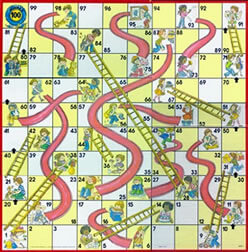 Other sources report that the phrase refers to Snakes and Ladders (Chutes and Ladders in the Usa) or like board games. The earliest citation of the phrase in print currently known is 1952, from the Britain publication the Economic Journal:
"He has the trouble of maintaining the interest of the reader who is always being sent back to foursquare 1 in a sort of intellectual game of snakes and ladders."
Some other early utilize of 'dorsum to square one', in the United kingdom newspaper The Liverpool Echo, Nov 1959, likewise refers to Snakes and Ladders:
If the farmer wins, the line may have to be changed. In a game of snakes and ladders, the Ministry building planners may find themselves dorsum at foursquare one.
Despite those citations, it isn't a usual characteristic of Snakes and Ladders that players are sent back to foursquare one. Of the many early examples of such boards that exist, only a few have a snake in the first square.
Hopscotch
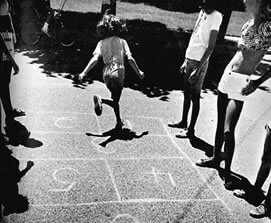 This playground game is played on a grid of numbered squares. The precise rules of the game vary from place to place but it ordinarily involves players hopping from square to square, missing out the foursquare containing their thrown stone. They ordinarily get from ane to viii or ten and then back to foursquare one.
The game's name derives from 'scotch', which was used from the 17th century to denote a line scored on the ground and, of course, hopping. It was referred to in the 1677 edition of Robert Winstanley'southward satirical annual Poor Robin:
"The time when Schoolhouse-boys should play at Scotch-hoppers."
Each of the above three explanations is plausible enough to gain supporters, although you would need to exist somewhat perverse to believe the get-go.
Equally is usual with phrases of uncertain origin, virtually people are happy to believe the first explanation they hear. There'south non plenty prove to put the origin beyond reasonable doubt, and so it remains uncertain. However, the Snakes and Ladders derivation has the strongest claim.
Whatsoever the source, 1952 is surprisingly belatedly as the earliest press for the phrase. Perhaps a printed source from before 1952 will yield the truth?
See also: back to the drawing board.
Source: https://www.phrases.org.uk/meanings/back-to-square-one.html
0 Response to "Back to Square One Again Meaning"
Enviar um comentário